Producing a factory profile video is more than just documenting manufacturing activities. For companies targeting overseas markets, these videos serve as a bridge of trust between manufacturers and potential international buyers.
In the export context, strong visuals can replace in-person visits, demonstrating how quality standards are maintained, how processes operate, and how the company’s commitment to safety and sustainability is implemented.
Why is Factory Profile Videos Important for Export Businesses?
In cross-border trade, trust is a key foundation. Potential overseas partners often don’t have the opportunity to visit production facilities in person. This is where factory profile videos play a vital role.
1. Building Global Credibility
Videos allow companies to showcase safety standards, international certifications, and compliance with global regulations. By displaying transparent operational procedures, companies signal professionalism and a commitment to quality.
2. Demonstrate Production Capacity
International buyers want to ensure that suppliers are capable of meeting large-scale demand. Through visuals of production lines, automation systems, and a trained workforce, videos provide tangible evidence of manufacturing capacity.
3. Explain Technical Processes Simply
Industrial technology and processes are often complex. Videos help simplify technical details into visual explanations that are easy to understand, even for non-technical users.
4. Emphasize Commitment to Sustainability
The global market is increasingly concerned about environmental issues and social responsibility. Showcasing environmentally friendly practices, waste management, and employee welfare programs can strengthen a company’s image in the eyes of international clients.
Key Elements of a Factory Profile Video
To be effective, a factory profile video needs to be designed with a clear content structure. The following components are crucial:
Visual Tour of the Production Facility
Aerial drone footage, combined with footage inside the production area, provides a comprehensive overview of the scale and layout of the factory. This visual creates a professional yet transparent impression.
Process and Technology Highlights
Details of machinery, assembly lines, and quality control points should be presented cinematically. Close-up visuals of high-tech machinery or automation systems reinforce the perception of modernity and efficiency.
Management and Employee Interviews
Showing the faces behind factory operations adds a human touch. A brief statement from a leader or production supervisor can reinforce the company’s commitment to quality and service.
Logistics and Export Readiness
Scenes of packaging, labeling, and container loading demonstrate the company’s readiness to distribute products globally. This is crucial for assuring potential buyers of a smooth supply chain.
Various Industrial Videos for the Global Market
Not all communication needs can be met by a single type of video. Depending on their marketing objectives, companies may consider the following formats:
Company Profile Film
It is a long video that outlines the entire manufacturing operation, company values, and long-term export vision.
In-depth Factory Tour
This format focuses on the experience of exploring the production facility in detail, as if the viewer were actually present on site.
Product Demonstration Videos
Highlight the qualities, features, and benefits of specific products to attract potential buyers at trade shows or online presentations.
Safety and Training Videos
Display safety standards and operational procedures to reinforce the company’s image as a responsible partner.
Factory Profile Video Production Stages
The industrial video production process requires careful planning to ensure optimal results and align with the target export market.
Pre-Production
The initial stage includes determining communication objectives, developing a script, creating a storyboard, and coordinating the shooting schedule. This phase also includes briefings on safety procedures in the factory area.
On-Site Production
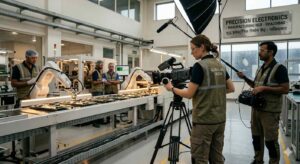
Shooting is conducted by professional with such as high-resolution cameras, drones, and stabilizer to produce dynamic visuals. The right angles can showcase both the details of the machinery and the scale of the facility.
Post-Production
This process includes video editing, adding animated graphics to explain technical data, color correction, and inserting subtitles or voiceovers in the target market’s language. The final product should be concise, informative, and easily understood across cultures.
Strategic Factors to Consider
For a video to be truly effective for the export market, the following points must be considered:
Highlighting Quality Standards and Certification
Display proof of compliance with relevant international standards.
Adjusting Duration
A short version is suitable for promotions via email or social media, while a full version is more appropriate for investor presentations or the company’s official website.
Language and Translation
Use subtitles or narration in the language appropriate for the export destination country to ensure a clear message.
Consistent Visual Branding
The visual style, color tone, and background music should align with the company’s identity to create a strong professional impression.
Video as a “Virtual Visit” for International Clients
Factory profile videos are an effective solution for creating a hands-on experience. With a transparent and informative visual approach, companies can expedite the negotiation process and increase the chances of long-term collaboration.
In the digital age, business decisions are often influenced by first impressions. A well-designed video can create a professional impression in minutes. This is why investing in quality industrial video production is a strategic move for export-oriented companies.
Time to Improve Your Export Image
If your business is targeting international markets, don’t let potential clients rely solely on brochures or static photos.
Entrust your industrial video production needs to SNXP Studio. With a strategic approach and thoughtful cinematic execution, SNXP Studio is ready to help your company appear more credible and competitive in the global market. Consult your project now and create a factory profile video that can open up wider export opportunities.
Frequently Asked Questions
What is the ideal length for a factory profile video for the export market?
2–5 minutes is generally sufficient for a short promotional video. For an in-depth tour or investor presentation, the length can be extended to around 10 minutes.
Is it necessary to use foreign language subtitles?
Subtitles or voiceovers in the target market’s language help clarify the message and enhance professionalism.
What is the main benefit of a profile video compared to a brochure?
Videos provide a realistic overview of the facility, processes, and production capacity, building trust more quickly.
How long does an industrial video production process take?
It depends on the complexity of the project, but generally takes several weeks from pre-production to post-production.